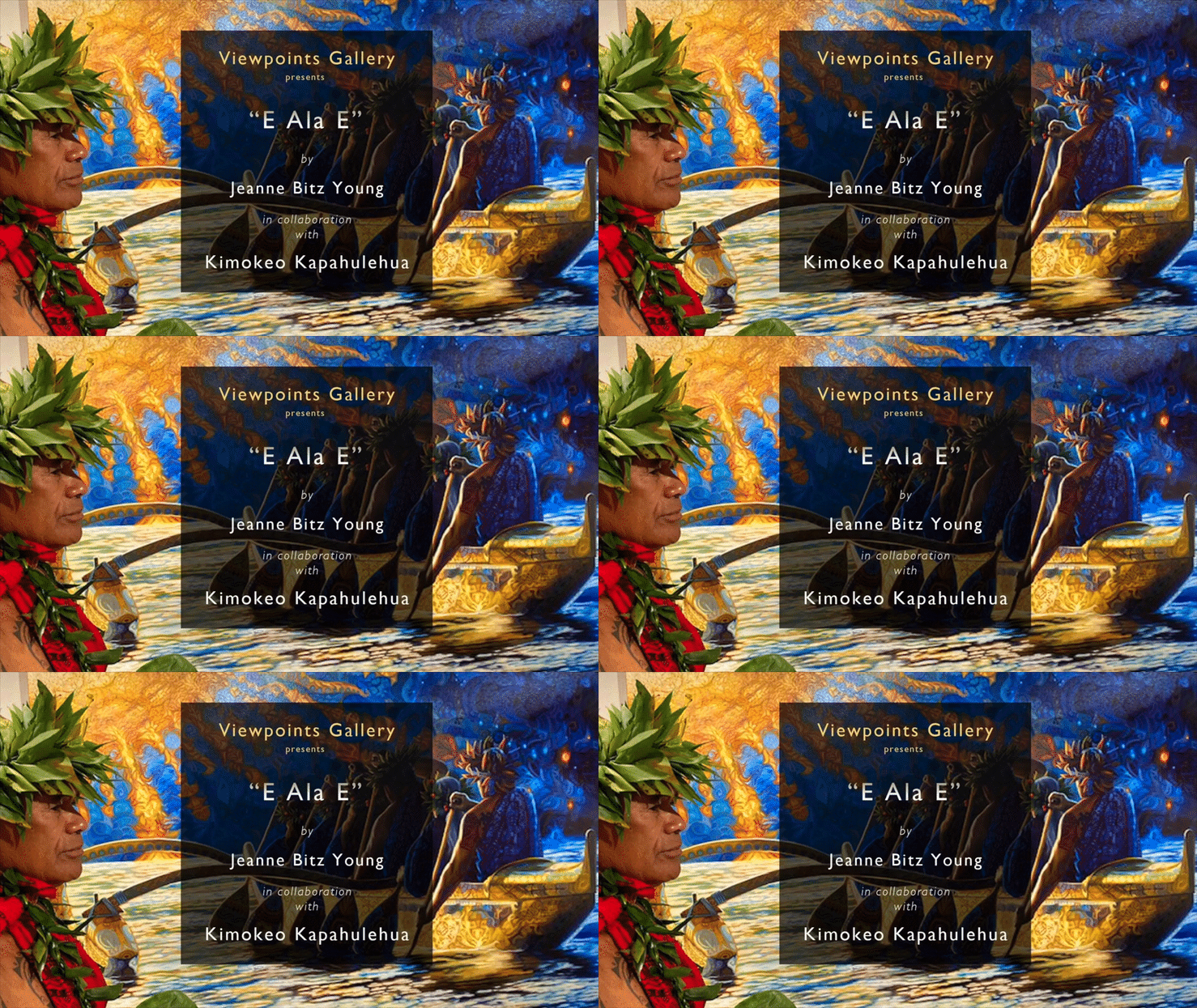
The Story of E Ala E
Jeanne Bitz Young, painter and Kimokeo Kapahulehua, leader of the Hawaiian Outrigger Voyaging Canoe Society dedicated to preserve and perpetuate the Native Hawaiian culture and its tradition.
For these projects, we ask the artists to create and explore the endless possibilities that may arise from working in collaboration with one or more partners being from a wide range of venues. More precisely, collaborations can be with another artist working in a different media or (and) preferably with one or more persons from the community at large (past collaborations have been with teachers, children, engineers, architects, botanist, family members etc…). Videos recording the process and the completed work are produced and viewed during the show.
Lā’ieikawai by Kathleen Storm
Lāʻieikawai is a high chiefess of Hawaiian antiquity. Her story is a legend of romance, recited for generations in prose interspersed with song from as early as the 14th century. In this painting she represents what is sacred, precious and hidden in Hawai’i.
About this interview
In this interview, Kathleen Storm shares the research behind her painting of Lāʻieikawai, the “princess of the rainbow.” Her story was told for generations in the oral tradition before Native Hawaiian historian S. N. Haleʻole — a schoolmate of David Malo — set it down in writing, serializing it in a Hawaiian-language newspaper in 1862–63 and publishing it as a book in 1863, considered the first work of literary fiction published by a Native Hawaiian. King David Kalākaua included an abbreviated English telling in his 1888 Legends and Myths of Hawaii, and Martha Warren Beckwith published a full translation in 1919.
Born a firstborn daughter when only a son was permitted, Lāʻieikawai was hidden at birth by her grandmother Waka — a moʻo, or lizard goddess — first in a cave beneath a pond, and later in Paliuli, a garden-of-Eden place in the uplands of Puna, in a house thatched with the golden feathers of the sacred ʻōʻō bird. Forest birds attended her, she traveled shrouded in mist, and a rainbow shining straight down marked her presence. Storm reflects on Hawai’i’s native honeycreepers, whose feathers adorned the capes of the highest aliʻi and whose survival is now threatened, and on the idea at the heart of the painting: what is precious is hidden.
Princess Ka’iulani by Jett Green
Princess Ka’iulani (1875-1899) was the last heir to the Hawaiian throne before the monarchy was overthrown January 17, 1893. She fought hard for Native Hawaiians to have voting rights under the new Territory of Hawaiʻi. Princess Ka’iulani is known as “The Peopleʻs Princess.”
About this interview
Jett Green discusses her painting “The Soul of a Queen,” a portrait of Princess Kaʻiulani (1875–1899), the last heir to the Hawaiian throne. Known as the Peacock Princess for the peacocks she fed by hand at her family home, Kaʻiulani was half Scottish and half Hawaiian, and Green — herself of mixed heritage — describes feeling an immediate kinship with her.
The portrait began from a black-and-white photograph that Green reimagined in color, moving from sunlight into the muted golds and blues of a Maui sunset so that the princess herself remains the focus. Behind her, Green painted a shield-like medallion of traditional Hawaiian tattoo designs — symbols of mountains and ocean, the rainbow maiden as messenger of the gods, guidance and protection — honoring a sacred art that was suppressed after the missionaries arrived and has since been reclaimed. Green speaks of Kaʻiulani’s devotion to her people, the culture, and the ʻāina, and of her fight for Native Hawaiians’ voting rights in the final years of her short life.
Hawaiian Ceremonies by Tina Ah Puck
These paintings honor the profound significance of ceremony in the Hawaiian culture, as the cornerstone of tradition and identity.
About this interview
Tina Ah Puck presents her two paintings in the Voice of the Ancestors exhibit. “Paʻakai” depicts a bowl of salt water — the basis of cleansing, blessing, and healing in Hawaiian ceremony since the beginning of time. Ah Puck studied lāʻau lapaʻau, Native Hawaiian healing, and describes how this single image of salt water carries the culture’s history: salt water is the ocean, and the ocean is life.
“Pō and Ao” (dark and light) portrays the traditional, sacred ceremony of Hawaiian tattoo. Married into a Hawaiian family from Maui, Ah Puck painted her own husband and daughter as models. She explains that traditional tattoo designs are chosen by an elder or kahuna, passed down within families, and carry deep meaning — honoring ancestors, voyages, accomplishments, or hopes for the family — and reflects on the responsibility of approaching the culture with respect while helping to perpetuate what deserves to be shared.
Hawaiian Goddesses by Anna Lindberg
Textile Goddess Sculptures depicting Hawaiian Goddess Hina and Haumea.
About this interview
Swedish-born artist Anna Lindberg discusses her crocheted textile sculptures of two of the most ancient Hawaiian akua: Hina and Haumea. A meticulous researcher who studied religious history at the postgraduate level in Stockholm, Lindberg explains the concepts of akua and mana, and why Hawaiian divinity — rooted in nature, embracing both light and dark — drew her in.
Her Haumea, goddess of abundant nature and childbirth, holds the flowers of a Maui garden — ginger and hibiscus — as offerings of the earth’s bounty. Her Hina, goddess of the moon and of kapa making, is portrayed as a mother holding the infant demigod Māui, recalling the legend in which Māui snared the sun to slow its passage so his mother would have daylight enough for her creative work. Lindberg describes beginning her textile goddess series in 2020, and her practice of asking permission of the ancestors before depicting them.
Sam Ka’ai by Suzy Papanikolas
Sam Ka’ai is a living legend and was on the first voyage of the Hokulea that proved navigation was done by the stars and the Hawaiians came from Tahiti. He is a master sculptor and a guide for the Hawaiian men helping to bring back their participation in cultural practices.
About this interview
Suzy Papanikolas tells the story behind her painting of Sam Kaʻai — master carver, cultural leader, and crew member on the first voyage of the Hōkūleʻa to Tahiti, which proved that Hawaiians navigated the Pacific by the stars, currents, winds, and birds, without instruments. Kaʻai carved the male and female figures that watch over the canoe’s stern, and served as a fisherman on that historic crossing, greeted in Tahiti by crowds on the beach.
Papanikolas recounts the vision of Herb Kāne, who founded the Hōkūleʻa project to prove the voyaging tradition; the young Nainoa Thompson, who would carry navigation forward to a new generation; and the second voyage’s capsizing, in which Eddie Aikau paddled for help and was never found — and after which Sam’s ceremonial conch, lost in the wreck, was recovered in the rescuers’ nets. She also describes the annual sunrise ceremony Kaʻai founded on Hawaiʻi Island to restore Hawaiian men’s participation in cultural practice, and her own years alongside him at the canoe-carving festivals of Lahaina. The painting shows Kaʻai across the seasons of his life — a living tribute to the revival of the culture itself.
Haumea by Joëlle C.
The story of the legend of Haumea in Waihe’e refuge as told by Scott Fisher and depicted in a painting by artist Joëlle C.
About this interview
Artist Joëlle C. is joined by Scott Fisher, who has cared for the Waiheʻe refuge for more than two decades, to tell the legend behind her painting. In ancient times Haumea, goddess of childbirth, safely delivered a child on Molokaʻi and received a sacred tree as an offering. She searched all of Maui for the right place to plant it, choosing a hill above present-day Waiheʻe School — and built the great sand dunes of Waiheʻe with her own hands to shelter the young tree from the shore winds. Generations later the tree was cut down; carried by the stream to the sea, it drifted to Oʻahu, where it was fashioned into a sacred temple image — its journey a cycle of life, death, and renewal.
Joëlle describes the layers of symbolism in the painting: the hau tree with its changing heart-shaped leaves, the breadfruit patterns of Haumea’s dress carrying tradition from past to future, the lama tree — whose name means light — honoring the storyteller, and the fish that follow the fallen tree out to sea, because life goes on. Together they reflect on mālama ʻāina: that in planting and caring for the land today, we reenact Haumea’s own devotion, and that when the land is healed, all of us are healed.
Ahupua’a Art Mural
The ancient Hawaiian Ahupua’a System of land division from the mountain to the sea, while caring for the sustainability of the land and water, is the theme of Waihe’e School mural art project that 88 fourth grade students created with the help of educator Mary Anna Grimes and artist Joëlle C.
About this interview
This video tells the story of a collaboration between Viewpoints Gallery artist Joëlle C., veteran educator Mary Anna Grimes, and 88 fourth graders at Waiheʻe Elementary School — a 145-year-old school in a valley within walking distance of the Waiheʻe wetlands refuge. The project brought the ancient Hawaiian ahupuaʻa system of land division, from mountain to sea, into the classroom through place-based, ʻāina-based learning.
The students learned how everything done on land affects the ocean, made field trips, and drew their own interpretations; Joëlle taught them to mix any color from red, yellow, and blue, then assembled their drawings — keeping their bold, uninhibited color and spontaneity — into the finished mural. Joëlle had first come to Waiheʻe School as an artist-in-residence 38 years earlier. Teachers and students reflect on what they learned: take care of the land, and the land takes care of you.
She Who Responds
Three women go on a pandemic-motivated online quest for creative collaboration. Will they be able to create an art piece while far away from each other?
“We instantly resonated with each other around a startling observation: nature was responding to the change of pace the lockdown imposed on humans – and her message was (and is) one of healing. This piece is our celebration of her response. Yet it asks: and now? Are you still listening?”
Beth painted “Her”, Mariabruna wrote the poem, Shelley created the vessels. Nature put in our hands pieces of “Her” that fit organically into the piece. Some asked for decoration, like the leaves; others, like the kelp, only wished to be draped. They are a statement of the interconnection that unites us all, and our only hope for healing.
About this video
In this video, the three collaborators tell the story behind the piece. When everything went silent in lockdown, Mariabruna — artist and poet — found that the stillness let her listen to nature differently, and the world answered: dolphins returning to harbors where they hadn’t been seen in decades. Her poem “She Who Responds,” born of a dream, became the foundation of the work. Shelley, a natural-fiber artist on Hawai’i Island, sculpted vessels of palm sheath fiber, soaked and hand-stitched into forms that shift as they dry; Beth painted the figure of “Her” — Gaia — on thin handmade paper that melds into the fiber so the palm texture shows through.
Working across islands and continents by video call, the three “popcorned” ideas without censoring: waxed quail eggs, a nest, a small clay “two-legged” figure nestled in a window of leather, hair that became water filled with dolphins and fish. What began as a pandemic collaboration became, in their words, a sisterhood — and a piece with a job to do: to keep asking whether we are still listening.
The Palila Project
The palila is a small yellow and grey honeycreeper endemic to Hawai’i. It is critically endangered. Between 500 and 1500 individuals are left in the world, all of them on the slopes of Mauna Kea.
About this video
Artist Sarah Taylor Ko describes building this body of work around makawalu — literally “eight eyes” — the Hawaiian concept of abundance of perspectives, in which even the empty spaces between the fingers hold plenty. Her collaborator, a University of Hawai’i at Hilo graduate researcher studying palila vocalizations from the first recordings in the 1970s to today, shared field notes, hand-drawn maps, and spectrograms that Ko collaged into eight paintings — treasure maps to a rare, vanishing corner of the palila’s world on the slopes of Mauna Kea, where the viewer hunts for a hidden bird or a māmane tree.
The project’s eight parts also included poems written from the birds’ recorded songs, clay palila eggs sent from around the world, and a mural painted with an 11th-grade class during COVID, using primary colors the students learned to mix themselves. Ko recounts standing at the entrance to the palila’s forest while her collaborator chanted an oli asking permission to enter — and how the research shows that as the palila’s numbers decline, so does the variety of their song.
Waihee Refuge
Betty Hay Freeland with Dr. Scott Fisher. Waihee Refuge is a 277 acre property owned by the Hawaiian Islands Land Trust. The Waihee site is deep in history with Hawaiian archaeological sites and structures from the plantation era. HILT bought the property in 2004 to preserve the archaeological sites, restore the native plants and animals, and outdoor recreation for locals
About this video
Landscape painter Betty Hay Freeland — born on Hawai’i Island, painting Maui in oils for decades — chose the 277-acre Waihe’e refuge for this collaboration, guided by two people who know it best: her daughter Denby Freeland, the refuge’s education coordinator, and Dr. Scott Fisher of Hawai’i Land Trust. Walking the land, she kept turning away from the ocean toward the sand dunes and the West Maui mountains — and those became her painting.
The video tells the refuge’s layered history: the fishing village and the loko i’a kalo, an ingenious dual-use pond where fish were raised among planted taro mounds; Maui’s largest fringing reef offshore; and the dunes — the last remnant of a system that once ran eleven and a half miles across central Maui, known as Mauna Ihi, the sacred mountain, said to have been built by the goddess Haumea to shelter a sacred tree. Fisher explains why the wetlands matter — they work like the land’s kidneys, and shelter Hawai’i’s endangered waterbirds — and why the Land Trust’s motto holds: we protect what we love, and we love what we know.
Cultural Heritage, Preservation and
Restoration of the Land
Melissa Chimera with Gene Dumaran (her uncle). This project celebrates her Filipino heritage and the Pu’unene HC&S sugar mill where her grandmother’s family worked on Maui.
Michael Clements with Maui County Council member Gladys Baisa. Many people in her family have been influenced both socially and economically by the Sugar Industry over the years and by it’s eminent demise.
Betty Hay Freeland with Scott Fisher, Director of Conservation, Hawaiian Island Land Trust. Interested in portraying landscape with a history that the public isn’t aware of. Nu’u, in Maui’s south east Kaupo district, is a wahi pana, a place of myths, legends and stories.
Carmen Gardner with Brian Sato. Fostering awareness of the historical and cultural significance of the island of Kaho’olawe.
About this video
This video follows four collaborations from the Reaching Out exhibit. Melissa Chimera, working with her uncle Gene Dumaran, traces her family’s story from a 1929 ship manifest — her grandfather arriving in Honolulu Harbor on the Fourth of July — to “The Last Harvest,” a glowing red oil painting of cane workers that honors the dignity within the hardship of plantation labor, patterned with the damask of a Filipino barong tagalog. Michael Clements invited Maui County Council member Gladys Baisa — granddaughter of a plantation locomotive driver — to paint freely on small canvases, which he cut apart and reassembled, crazy-quilt style, into a vibrant sugar mill scene celebrating an industry at its end.
Betty Hay Freeland painted Nu’u in Maui’s arid Kaupō district with Hawai’i Land Trust’s Dr. Scott Fisher, who describes its petroglyphs, village sites, and spring-fed coastal wetlands — a wahi pana, a storied place, inhabited since around 1500. And Carmen Gardner painted from photographs by Brian Sato, who has volunteered on Kaho’olawe, to foster awareness of the island’s cultural significance and its slow restoration after decades as a bombing range.
Circle of Wisdom
Joelle C. with Timothy Paulokaleioku Bailey
Creating art that relates to the concept of the “Aha Moku system.” Together with the Kumulipo, the Aha Moku system provides the best guidance for caring for the land and resources.
About this video
Joëlle C. recounts how a presentation at the gallery by Timothy Paulokaleioku Bailey — farmer, cultural practitioner, and keeper of the Aha Moku tradition — set this painting in motion. The Aha Moku system, shared by the late kumu hula John Ka’imikaua, is the ancient framework by which Hawaiian experts — fishermen, farmers, healers — wove their knowledge together like strands of cordage to manage land, ocean, and sky, dividing Maui into twelve moku, each containing every resource a community needed.
Bailey explains the painting’s structure: read in quadrants, it holds the four great gods — Kanaloa of the ocean, Kāne of the waters, Kū and Lono — while Maui itself is understood as a woman’s body, and his own traditional tattoos, including the flight pattern of the nēnē, are woven into the landscape. Joëlle, uncertain whether it was her place as a non-Hawaiian to paint this knowledge, asked for a sign — and received it in a dream in which she was asked where she was traveling, answered “to the Aha Moku system,” and was told: you can go.
Botany and Physics
Gwen Arkin with Olin Erikson – head gardener with The Merwin Conservancy. Both of eager to explore the combination of the organic matter in seeds, fruits and flowers (the natural source) with the organic matter in photographic emulsions (a chemical source).
Denby Freeland-Cole with Anna Dodd and her family at Ola Mau Farms. Exploring the varieties of taro they have been growing deepening her awareness of taro and expanding her knowledge of dyes from Hawaiian plants.
Terry Lopez with Judy Bisgard and physicist Dr. Garret Lisi. The challenge for us was to create an art piece that juxtaposes the organic world with the mathematical one.
Karuna Santoro with Rich von Wellsheim from Whispering Winds Bamboo in Kipahulu. This piece represents the many connections we all have with people and things around us, the threads that bind and hold us together.
About this video
Four collaborations pairing artists with growers and a scientist. Photographic artist Gwen Arkin worked with the palm collection manager of the Merwin Conservancy — the poet W. S. Merwin’s 40-year palm forest in Ha’ikū, among the world’s largest private palm collections — gathering seeds and plant matter from the garden to make lumen prints: camera-less images formed by the chemistry of plants reacting with aged silver-gelatin paper in sunlight, finished in wax. Denby Freeland-Cole collaborated with a family growing dozens of heirloom kalo varieties, making kapa dyed with taro-derived colors — one piece depicting the Hawaiian moon calendar, honoring the family’s practice of planting by the full moon.
Terry Lopez read about physicist Garrett Lisi — whose “E8 theory of everything” work is done partly on Maui — and boldly wrote to ask if his geometric drawings could enter a painting; with Judy Bisgard she built two encaustic panels, the artists trading them back and forth, each simplifying the other’s density until “history showed through.” And Karuna Santoro worked with a Kipahulu bamboo grower, marrying cross-cut black bamboo with her glass rounds in a circular piece called “Connections.”
Beth Marcil and Celina
“They said that she was pure of heart, and that all living things, both innocent and wild, felt safe in her presence. The children of the village chose her to be their queen for she was the one they trusted above all others. “Be kind,” she said. “Take care of the earth and of each other.” And so they did.
About this video
Painter Beth Marcil and her ten-year-old collaborator Celina describe creating their piece together — a queenly figure Celina described simply: someone everyone can trust, “the right one to be a ruler of everyone.” Celina’s first sketch was so good that Beth abandoned her own, and it set the feeling for the whole painting.
Asked at the exhibit’s first gathering what collaboration meant to her, Celina gave the answer that stopped the room: “Collaboration is when you work together and you trust each other.” The two describe a process full of checking in with each other, texture play, dancing, singing, and improvised Russian accents — and Beth reflects that working with a child taught her to let go of perfection: “I just did it. It turned out awesome.”
Partners in Peace
Mary Ann Leigh and Ted Loberg. Collaborating on these art pieces present an opportunity to share in creating one concept by taking two materials and approaching the work from opposite directions.
Tim Garcia with the Lama Gyaltsen (at the stupa) and Lori Koprowski. Walking The Stupa – A collaboration, a journey, a transition.
Suzy Papanikolas with Richard Tillinghast, award-winning poet and travel writer, and calligrapher Linda Jenson. The approaches taken allude to Asian art, and the result is of dancers, chanters and musicians from Hawai’i’s hula culture, traditional and modern at the same time.
Jim Powlan with Steve Gera. The art pieces represent the harmony of man and nature. We are using new techniques never tried before – blending etched & inked copper with paint and clear coating, mounted onto hand built wood forms finished in Koa.
About this video
Four partnerships in one video. Mary Ann Leigh and Ted Loberg — married 38 years — combined his hand-finished Philippine mahogany with her vertically-fired, oxide-glazed ceramic ribbons in “Dawn to Dusk”: walk toward it one way and Lāna’i glows in warm copper morning tones; approach from the other side and it cools into evening blues. Their second piece reaches ceramic hands out of a bamboo thicket — anyone who has wandered too deep into a bamboo forest will understand. Tim Garcia sought out the lama at the Pā’ia stupa, and walking the stupa became his meditation; carver-painter Lori Koprowski incised his milo and monkeypod panels with feminine forms, butterflies, and silver.
Suzy Papanikolas painted Maui’s sea cliffs in the spirit of classical Chinese brush painting, joined by award-winning poet Richard Tillinghast, whose spare, haiku-influenced poems were lettered onto the canvases by calligrapher Linda Jenson. And Jim Powlan reached out to builder Steve Gera to create “Story Lines” — tar-painted, acid-etched copper panels mounted on curved wood forms, telling Maui’s story from the storms that seeded a newborn volcanic island through agriculture, many cultures arriving, and the land’s return to nature.
Relationships & Collaborations
A selected group of artists has been invited to collaborate and create some unique works of art. They were free to choose to work with anyone they wanted to… artist or not! One partner or several… The project is focusing on the process leading to the creation as well as to the completion of the artwork. With the help of coaches and researchers in the field of relationships, the participating artists have been led through inspiring processes to enhance their capacity to relate on a deeper level: to themselves, their artistry, their creative partners and the endless possibilities that may arise from this exploration.
About this video
This video documents the workshop concept behind the exhibit: professional coaches led the participating artists through practices of presence — distinguishing intuition, which “speaks very gently,” from intellect and instinct — and challenged them to leave their “known zone,” where every choice comes from the past and the predictable. Artists speak candidly about vulnerability as strength, attachment to outcomes, and the moment a partner’s marks take a painting somewhere neither could have gone alone.
The collaborations shown span generations and disciplines: a woodworker honoring the ko’ihonua — genealogical chant — of a collaborator from a distinguished hula lineage, in Hāna-grown woods and natural dyes; a ceramicist’s textures handed to a painter to transform into rusted patinas; couples and friends passing canvases back and forth; and a prayer wheel of hand-bent metal set into the exposed heart of an old-growth pine from Polipoli — one tree, one spin, one thought at a time, a prayer for the healing of the earth. As the gallery’s art director says of these shows: it’s hard to get people to come to openings on Maui — here, it’s hard to keep them away.
Reaching Out – Exhibit
Artists creating and exploring the possibilities arising from collaborating with family members who are videographers and contractors, or one’s own child, or working with a couple of students from Paris and New York, then a healer or a well-known biologist whose work focuses on preserving the native environment, a local architect interested in the history of local Hawaiian architecture, and finally with a poet exploring the deeper meaning of the “Aloha Spirit”…
About this video
The full tour of the Reaching Out exhibit, in the collaborators’ own voices. A fiber artist who felts wool and beats kapa worked with biologist Dr. Art Medeiros, who has spent decades restoring Maui’s native forest — “the last survivors of old Maui” — producing “Mālama” and “Rarer than Gold,” a kapa portrait of a young girl holding rare native fruit, an image of hope that the forest and its children will grow up together. Silk painter Kudra Clover collaborated with her doctor of Chinese medicine on “Galaxia,” letting the Tao guide spirals that are at once microscopic sea creatures and galaxies.
Elsewhere in the show: a mother-daughter pair paint side by side, masks and lace and generations flowing between them (“It took Picasso a lifetime to learn to draw like a child”); painter George Allen, his stepson, and a filmmaking daughter-and-son-in-law team build a koi pond whose painted lily pads float on a video screen; Joëlle C. mentors two young artists — a RISD student and her 13-year-old goddaughter from Paris — into a Kandinsky-inspired chronicle of a Maui summer; a married artist duo honors Auntie Pilahi Pakī’s Aloha Spirit Law — kindness, unity, agreeableness, humility, patience — in layered paintings carrying hidden messages on their backs; and Terry Lopez collaborates with a young Maui-born architect, embedding his sketchbook “thought bubbles” and drawings in encaustic wax the colors of ocean, cane field, and red dirt.